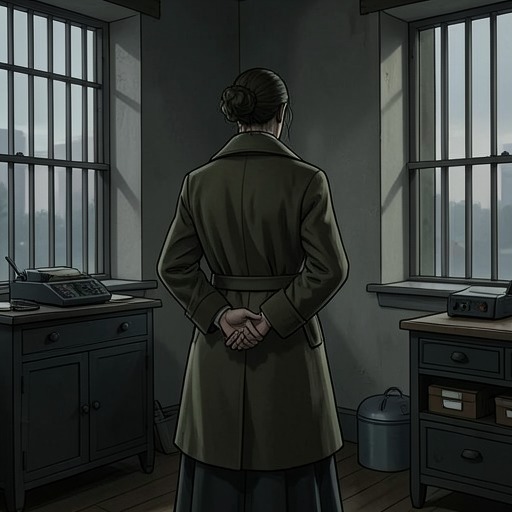
Smilla escapes the Kronos
Smilla's Sense of SnowSmilla’s escape from the Kronos infirmary is a turning point in which she recovers her freedom of movement and brings the ship’s hidden chain of responsibility into the open. Injured and under guard, she finds the means to leave confinement, confronts Maurice and Captain Lukas, and finally tells Lukas what she has learned about Jakkelsen’s murder and Tørk’s role.
From Confinement to Action
The escape begins with objects hidden in the infirmary rather than with a clear route out. Beneath the cushion Smilla has used as a pillow, she finds Jakkelsen’s key, a blue plastic container, and a cloth-wrapped revolver. The discovery gives her a weapon and a possible means of passage, but possession does not make her secure: the mechanic has not returned, and Smilla has no assurance that she can get past the people controlling the ship. Her decision to act is therefore made under uncertainty, with the key, the revolver, and her own judgment as her available resources.
She draws Maurice into the room by making a rattling cough and kicking at the remaining glass in a cupboard door. When he comes in, she holds the revolver with both hands and orders him to his knees. The threat does not immediately work. Maurice advances, and Smilla discovers that she has left the safety on; he strikes her and knocks her down. Recovering, she uses scalpels carried in her work-clothes tool pouch to disable him, then strikes him with the revolver when he continues to move toward her. She does not wait to see whether he can recover. She leaves, locks the door behind her with his key still in the lock, and enters an otherwise empty corridor. The encounter turns confinement into a dangerous, temporary opening: Maurice is no longer in immediate pursuit, but Smilla has had to use force and remains exposed aboard the ship.
Confronting Lukas and Naming the Killers
In the mess, Smilla pauses to make herself coffee while Urs sets the table, then persuades Captain Lukas to leave his room with her. At sea, doors are ordinarily locked only when someone exits, to keep passage clear in a fire; Lukas is asleep behind an unlocked door. Smilla enters, sits at the foot of his bunk, and tells him she has temporarily discharged herself. When he tries to seize her, she shows him the revolver and raises its barrel toward his face, then insists that having Maurice outside is no protection. Lukas puts on his outdoor clothes, and they go onto the deck.
Smilla keeps her distance from Lukas by the railing, making it harder for him to grab her. When Sonne comes down from the upper decks, Lukas waves him past; after hesitating, Sonne steps aside, and Smilla and Lukas continue. The captain’s first appeal is that she should return because arrest is her security. Smilla instead tells him that Tørk is right to call her sick. She recognizes a numbness between herself and the world, but continues to hold Lukas at a distance long enough to speak.
As Lukas drops the courtesy he had maintained, Smilla concludes that it was never truly his own: it belongs to Tørk, along with the justice enforced aboard the ship. She sees Lukas as a tool rather than the source of the ship’s authority. Before he walks away, she states that Verlaine killed Jakkelsen and that Tørk sent the telegram. That accusation brings Lukas back to stand beside her and look out across the island.
Smilla then recounts what she knows, from the beginning. The disclosure takes long enough for the wind to die down and the light to seem changed; Lukas listens without changing expression, lighting one cigarette after another with deliberate care. The escape thus becomes more than a physical break from the infirmary: it gives Smilla a chance to confront the captain with the murder and expose the responsibility she attributes to Verlaine and Tørk. Lukas’s eventual smile marks the end of her account, though the evidence here does not establish what he does next.
Escape as Disclosure
The confrontation with Lukas changes the escape from a bid for physical liberty into an act of testimony. Before he leaves, Smilla names the two acts she believes connect the ship’s violence: Verlaine killed Jakkelsen, and Tørk sent the telegram. Lukas returns to stand beside her, looking across the island while she tells him everything from the beginning. His face does not change as he listens. He lights one cigarette after another with meticulous care, while the wind dies and the light seems to shift. The quiet, extended telling contrasts with the force that brought Smilla out of the infirmary: she now uses the space she has won to make the concealed history audible.
The scene ends with Lukas straightening and smiling, but does not establish what he will do with what he has heard. Smilla has escaped immediate confinement and placed her account before the captain; the outcome of that disclosure remains unresolved. Her freedom is therefore real but provisional, while the act of speaking turns escape into a confrontation over who controls the ship’s version of justice.